Part 1
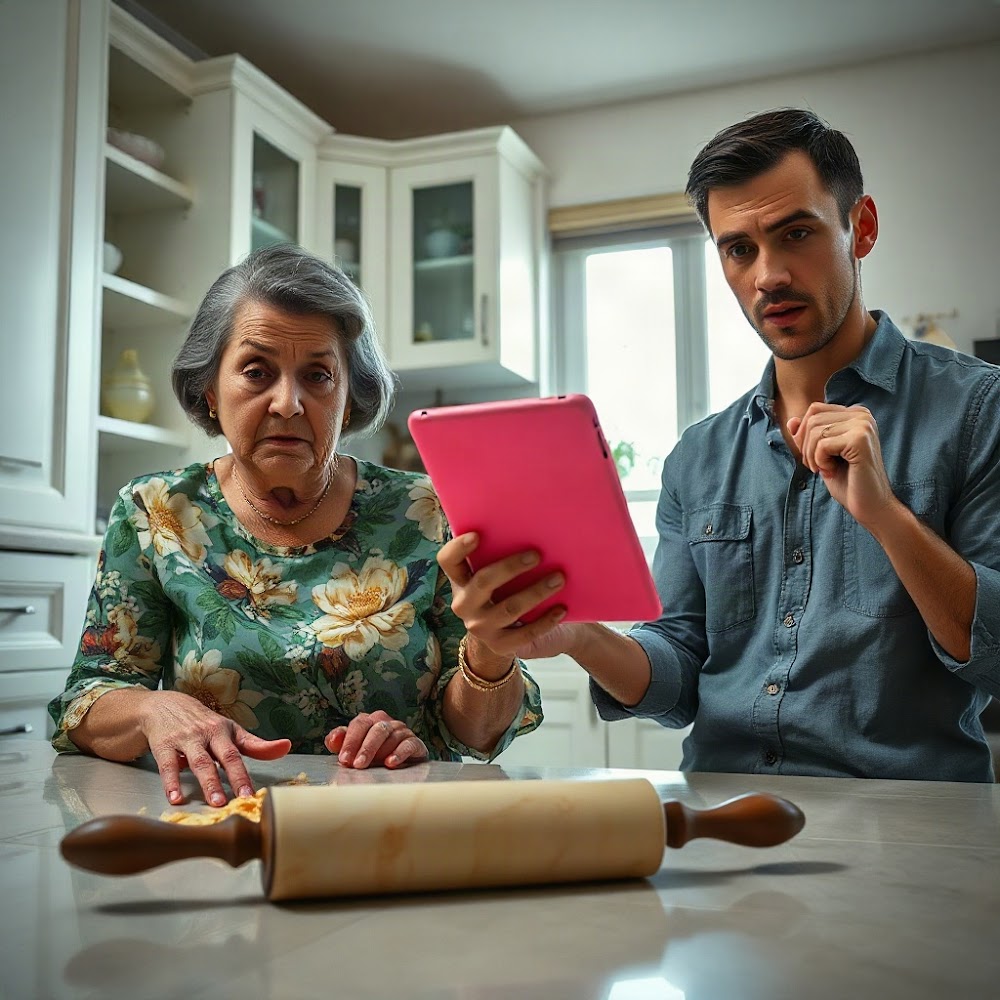
The rolling pin came down on my shoulder blade for the fourth time before I heard the front gate scrape open.
I was already on the kitchen tile, one knee folded under me, the other leg twisted out sideways like a doll somebody had thrown.
My mother-in-law, Colette, stood over me with both hands wrapped around the wooden handle like she was kneading dough that had wronged her.
"Get up," she hissed. "Get up before he sees."
I couldn't get up. My left arm wouldn't answer. There was a hot wet stripe down the back of my neck where the first blow had split the skin behind my ear.
Six minutes earlier I had told her no.
That was all. No, she could not go through the lockbox in our bedroom closet. No, she could not have the spare key. No, I was not going to "stop being dramatic about a stupid drawer."
She had smiled at me the way she smiles at the grocery clerk who short-changes her. Then she had walked past me, opened the drawer under the microwave, and taken out the marble pin she uses for her Sunday galettes.
I am 5'2". I weigh 104 pounds on a good week. My right wrist has three pins in it from a bike accident when I was 19. Colette is a woman who has spent 62 years lifting other people's furniture and other people's children and she was, at that moment, absolutely calm.
The first swing caught my forearm when I lifted it.
The second caught my ribs.
The third put me on the floor.
The fourth was the one my husband almost walked in on.
I heard Julien's key in the door and I felt something in my chest unclench, which was, I will tell you now, the single stupidest thing I have ever felt.
Because Colette dropped the pin.
She dropped it, and in the same motion she sat down hard on the tile beside me, and she started to cry.
Not the way a person cries. The way a person auditions crying. Wet, loud, shoulders working like a bellows.
"Julien," she wailed. "Julien, oh God, she wouldn't stop, she wouldn't stop, look what she did to me."
I stared at her.
She had, at some point in the last thirty seconds, dragged her own fingernails down the inside of her wrist. There was a shallow scratch there, freshly beaded. She was holding it out toward the hallway like an offering.
Julien came around the corner with a bag of oranges in one hand.
He saw his mother on the floor. He saw the rolling pin. He saw me, propped against the dishwasher, one side of my face already going the color of a plum.
His eyes went to her wrist.
Only her wrist.
"She attacked me," Colette sobbed. "I asked her about the electric bill and she just, she just, oh Julien, I told you. I told you she was getting worse."
I opened my mouth and nothing came out. Not because I couldn't speak. Because the shape of what had just happened was so large I could not find an edge of it to grab.
"Mom." Julien was on his knees beside her. Not beside me. Beside her. "Mom, breathe. Breathe. Where does it hurt."
"Everywhere," she whispered. "Everywhere, my baby."
He looked at me over the top of her gray head.
He looked at me the way you look at a stranger who has done something unforgivable in public.
"What is wrong with you," he said. Quietly. Like he was afraid of the answer.
I tried to say her name. I tried to say the pin. I tried to say she went for the closet, she wanted the closet, ask her about the closet.
What came out was a sound I didn't recognize.
Colette turned her face into my husband's shoulder and, from that safe hidden angle, she looked directly at me.
She smiled.
It was a small smile. Private. The kind you give someone across a dinner table when you have just won an argument they didn't know you were having.
Then, from the hallway behind Julien, a small clear voice said,
"Papa, I filmed it. From the beginning. Mémé is lying."
And in my daughter's hand, held out flat like a communion wafer, was the old pink tablet we had told her a hundred times not to sneak into the kitchen, its screen still lit, its little red dot still blinking, and Colette's own voice, tinny but unmistakable, mid-sentence:
"...if you don't hand me that key I swear to God I will make it look like you came at me first."
PART 2: The Red Dot
Nobody moved for what felt like a whole minute but couldn't have been more than four seconds.
The pink tablet went on talking in my daughter's small steady hand.
"...make it look like you came at me first."
Then a pause on the recording. Then the wet crack of the first blow, and my own voice, thin, saying please.
Léa did not flinch at the sound. She had already heard it once, live, from the hallway.
She is seven. She was wearing the unicorn pajama pants she refuses to take off before noon on Saturdays. She held the tablet out toward her father the way you hold out a broken plate you did not break.
"Papa," she said again. "From the beginning."
Colette's face did something I will spend the rest of my life describing badly.
The crying stopped. Not tapered. Stopped. Like a tap.
Her mouth stayed open in the shape of the crying, but the sound had left it, and what was left was a woman looking at a seven-year-old the way a cat looks at a bird that has flown into the wrong room.
"Give me that," she said.
Julien said, "Mom."
"Give me that, Léa. That's Mémé's. That's not for playing."
It was not hers. She had bought it for Léa's fifth birthday and then complained for two years about the cost of the case.
Julien held out his hand. Not to Colette. To his daughter.
Léa walked past her grandmother without looking down and put the tablet in her father's palm.
Then she came and sat next to me on the kitchen tile, very carefully, on the side of me that wasn't purple, and she put her small warm hand on my knee like she was pinning me to the ground so I wouldn't float away.
Julien scrolled the recording back to the beginning.
He watched it standing up, one hand braced on the counter.
I watched him watch it. I watched the color leave his face in a specific order, forehead first, then the strip under his eyes, then his mouth.
I watched him get to the part where his mother said the sentence about making it look like I came at her first. I watched him get to the crack of wood on bone. I watched him get to the moment where, on the tinny audio, his own key was already scraping in the lock, and Colette's breathing changed, and she started to cry.
He watched the crying begin.
He watched it begin before he had walked in.
"Julien," Colette said. Her voice was flat now. All the wet had gone out of it. "Julien, sweetheart. She coached the child. Look at me. Look at your mother. She has been coaching that child for months. You know how she is with her. You know."
He did not look at her.
"Julien. Julien, the child adores me. The child would say anything. You know the child would say anything if her mother told her to."
He put the tablet down on the counter. Face up. Screen still lit.
"Mom," he said. "You said you were going to make it look like she came at you."
"I said no such thing. That is edited. That is a phone. Anyone can, anyone can, Julien, look at me, anyone can put words on a phone."
"It's a video, Mom."
"It's a phone."
"It's a video." He said it again, softer, like he was the one being asked to believe something impossible.
Colette stood up.
She stood up with no difficulty at all. No hand on the counter, no wince, no favoring of the wrist she had been holding out like a wound thirty seconds earlier. She stood up the way she stands up from her Sunday chair after the news, brisk, annoyed, already thinking about the next thing.
"Fine," she said. "Fine. Delete it."
"What?"
"Delete it. Now. In front of me. And we will not speak of this again. Your wife is hysterical, your daughter is a parrot, and I will be gracious enough to pretend none of this happened."
She held out her hand for the tablet.
Julien looked at his mother's hand.
Then he looked at me.
It was the first time since he had walked in the door that he had actually looked at me. Not glanced. Looked. At my face, at the plum swelling shut around my left eye, at Léa's hand on my knee, at the way my left arm lay in my lap like something borrowed.
His jaw did a thing.
"Get in the car," he said.
"Excuse me?" said Colette.
"Not you." He crouched down in front of me. He did not touch me. He had the sense, at least, not to touch me. "Camille. Can you stand."
I could not stand. I said so with my chin.
"Okay. Okay. I'm going to lift you. Tell me where."
"Not the ribs," I said. My voice was a whisper made of dust. "Not the left side. Anywhere else."
He got his arm under my right side and Léa scrambled up and grabbed the tablet off the counter before her grandmother's hand could close on it. She held it against her chest, screen in, like a book she was hiding from a teacher.
"Julien," Colette said. "Julien, if you take her to a hospital they will ask questions. Do you understand what you are doing. Do you understand what she will say. Julien."
He walked me past his mother.
He walked me past her without a word, and I felt her watch us go, and I felt, for the first time in the eleven years I had known her, that she was afraid of something.
Not of me. Of the tablet.
The urgent care on Rue Corneille was empty on a Saturday afternoon in the way only French urgent cares are empty, which is to say there were six people ahead of us and all of them waved us forward the moment they saw my face.
The intake nurse was a woman in her fifties with hennaed hair and reading glasses on a beaded chain. She looked at me, then at Julien, then at Léa clutching a pink tablet, and her mouth went into a straight line I recognized from my own mother.
"Ma'am," she said to me. Only to me. "Can you tell me what happened."
Julien opened his mouth.
"Sir," the nurse said, without looking at him, "I asked her."
I told her.
I told her in the shortest sentences I have ever used. My mother-in-law. A rolling pin. Four blows. The closet. The lie.
She wrote it all down. She did not ask me to repeat anything. When I got to the part about Colette scratching her own wrist, the nurse's pen paused for exactly one beat and then kept going.
"Sir," she said, still writing. "Step into the waiting room, please."
"She's my wife."
"Yes. Step into the waiting room, please. The child can stay."
Julien stepped into the waiting room.
The doctor was a young man with tired eyes who palpated my shoulder blade with the pads of two fingers and said, without looking up, "Fractured scapula. We'll image it, but I already know."
The X-ray confirmed the scapula and two ribs on the left, floating and eight, both cracked, neither displaced. The stripe behind my ear took four staples. The forearm was only bruised, which the doctor said with the small satisfaction of a man delivering the one piece of good news in a bad afternoon.
He also, without me asking, without Julien in the room, filed the médecin légiste paperwork that starts a police report on its own rails whether the patient signs anything or not.
"You do not have to press charges today," he said, capping his pen. "But the document exists. The photographs exist. In six months, in two years, if you decide, the document will still exist."
Léa, on the chair by the wall, was drawing something on the back of a discharge form with a hospital pen. She had not put the tablet down since we left the kitchen. It sat on her lap under her drawing hand like a warm animal.
Julien came back in when they let him.
He looked at the sling. He looked at the staples. He looked at the printout of the scapula on the light board, where the fracture was so clear even I could see it, a pale line running through the bone like a hair in milk.
"Cam," he said.
"Don't."
"Cam, I'm going to file the report. Today. Now. From here."
The nurse with the henna hair was standing in the doorway with a clipboard, and I watched her face when he said it, and I watched her face when I answered.
"No," I said. "Not today."
Julien said, "What?"
"Not today."
I was not protecting her. I want to be extremely clear about this, in case it matters later, to me, in a mirror. I was not protecting Colette.
I was looking at my husband's face, at the specific gray under his eyes, at the way his hands were shaking on the strap of Léa's little backpack, and I was thinking about the tablet, and about the closet, and about what a woman who had planned the sentence make it look like you came at me first had probably also planned around it.
One pin. One recording. One afternoon.
I did not yet know what else was in my house.
"Tomorrow," I said. "Or Monday. I want to go home first."
"Camille, you cannot go home."
"Not that home. My aunt's."
The nurse wrote something on her clipboard.
Julien said, very quietly, "Please. Let me try to fix this. Twenty-four hours."
Colette had said Julien to him fourteen times in six minutes and he had walked past her.
He was saying please to me now for the first time in maybe a year.
I looked at Léa. Léa looked up from her drawing. She had drawn, in blue hospital pen, a rectangle with a small red dot in the corner.
"Okay," I said. "Twenty-four hours."
I did not know, when I said it, that twenty-four hours was exactly enough time for a woman like Colette to start burning the paper.
PART 3: The Yogurt Shelf
My aunt Véronique died in March.
She left me a stone cottage in Sancerre with a slate roof that needs replacing, a kitchen garden gone to bolt, and, in a Crédit Agricole account I had not yet touched, the entire proceeds of the sale of her Paris apartment. Two hundred and eighty-one thousand euros and change.
I had told exactly three people. My husband. My notaire. And, at Julien's insistence, one Sunday in April over a chicken his mother had roasted too dry, Colette.
"She's family," he had said, on the drive over. "She'll be hurt if she finds out later."
I remember that Colette had put down her fork when I said the number.
I remember that she had not picked it up again for the rest of the meal.
I remember that she had smiled, and said how nice for you, dear, and asked whether we were going to be sensible with it or foolish.
I remember thinking, at the time, that sensible was a strange word to reach for.
We slept at Véronique's cottage that first night, all three of us in the one made-up bed, Léa in the middle with the tablet under her pillow because she would not be talked out of it. Julien lay on the outside with his back to us, and I could tell by his breathing he did not sleep.
In the morning he drove back to the flat to get us clothes and Léa's insulin kit, because Léa is Type 1 and we had left in the state you leave in when the state of leaving is the only state available.
He was gone six hours.
He came back with two suitcases, the insulin kit, Léa's stuffed otter, and a face that had gone a color I did not have a word for.
"She's not there," he said.
"Who."
"My mother. She's not at the flat. She took her overnight bag. She took her pills. She took the lockbox."
I sat down very carefully on my aunt's kitchen chair.
"She took the lockbox."
"It's not in the closet. The closet is open. The, the little shelf where you kept it is empty. There's a mark in the dust where it was."
Léa said, from the doorway, "Did she take my scooter."
"No, ma puce, she didn't take your scooter."
"Okay."
Léa went back to the garden.
Julien sat down across from me. He put both hands flat on the table like a man being questioned.
"There's something else," he said.
I waited.
"The yogurt shelf."
For eleven years my mother-in-law has kept, in our refrigerator, a specific shelf that is hers. Second from the top, left side. Four yogurts, always four, always the same brand, always with a small piece of masking tape on each lid on which she has written, in her round primary-school hand, COLETTE. Not the date. Not the flavor. Her name.
Julien had, exactly once, in year three of our marriage, moved one of her yogurts down a shelf to make room for a birthday cake. She had not spoken to him for four days. She had not spoken to me for eleven.
The yogurt shelf is a family joke. It is the thing his sister and I text each other about when we cannot text each other about the other things.
"What about the yogurt shelf," I said.
"It's empty. She cleared it. She took the yogurts."
"She took the yogurts."
"She took the yogurts, Camille. She took four yogurts from a fridge she is never coming back to."
We sat with that.
A woman who had, six minutes into an argument about a lockbox, picked up a marble rolling pin and broken my scapula, had also, on her way out of the flat, stopped to clear her labeled dairy from a shelf she had defended for a decade.
"She's not planning to disappear," I said.
"No."
"She's planning to come back."
"She's planning to come back and she does not want anything of hers in a place where you could touch it."
The tablet was on the table between us. Léa had left it there, screen down, when she went to the garden. Julien turned it over. The battery was at 14 percent. He plugged it into my aunt's ancient outlet with an adapter he found in a drawer.
"Cam," he said. "The closet."
"Yeah."
"What was in the lockbox."
I told him.
Passports, all three. Our marriage livret. Léa's birth certificate. The notarized copy of my aunt's will. The Crédit Agricole account paperwork, including the RIB with the account number and the signature card. Two thousand euros in cash for emergencies. My grandmother's ring. A USB stick with copies of everything.
Julien said a word he does not say in front of Léa.
"The USB is on my keyring," I said. "She didn't get the USB."
"Cam. She didn't need to get the USB. She had the paperwork for months."
"What."
He was already up. He was already going through his own bag for his laptop. He was already logging into the joint household account, the small one, the one we use for the electricity and the internet and Léa's swimming lessons.
He turned the screen toward me.
Three transfers, in the last six weeks. Each one for four hundred and eighty euros. Each one to an account labeled, in the memo field, in his own name, LOISEAU J. VIREMENT INTERNE.
He had made none of them.
"That's not," he said. "That's not my."
"I know."
"That's not, Cam, I did not."
"I know."
Then, and I will remember this, he put his forehead down on the kitchen table my aunt had eaten breakfast at every morning for forty years, and he made a sound like a dog that has been shut out in the rain.
I put my good hand on the back of his neck.
I did not say it's okay. It was not okay.
I said, "Get up. Get the bank on the phone. Now. Before Monday."
He got up.
Léa came in from the garden with a snail on the back of her hand and said, "Mama, why is Papa crying."
"He's not crying, ma puce."
"He was making the noise."
"He's tired."
She looked at me the way she had looked at Colette from the hallway. Steady. Old.
"Okay," she said. "I'm going to name the snail Gérard."
She went back out.
Julien got Crédit Mutuel on the phone on a Sunday, which is a small miracle and a large indication of how he sounded when he called. He put it on speaker. A woman named Madame Thiébaut, patient, professional, took him through the three transfers one by one.
"Sir, these were initiated from a device we have on file as authorized. The IP address on all three matches the address you have registered as your domicile. The transfers were pushed through with a code sent to the phone number ending 47."
"That's my mother's phone."
A pause. "Sir. You have your mother's phone registered as a secondary authentication device on this account."
"I did not do that."
"It was added on the fourteenth of February of this year, sir. From the same device, at the same IP."
Julien had been in Brussels on the fourteenth of February. For work. Three days. His mother had stayed at our flat to look after Léa, because Léa had the flu and I had a deadline.
His mother had had, for three days, unsupervised access to his laptop, his phone charger, and the drawer where he keeps the little paper on which, against every piece of advice ever given by any bank, he had written down his passwords.
Madame Thiébaut was still talking. Something about a fraud form, something about a seventy-two-hour reversal window on the most recent transfer, something about needing to come into a branch with ID.
Julien was not listening. He was looking at the wall.
"Ask her," I said, into the phone. "Ask her about the home equity."
"I'm sorry, ma'am?"
"Is there anything else on that account or any linked account. Any application. Any inquiry. Anything opened in the last six months."
A longer pause. The sound of typing.
"Ma'am," said Madame Thiébaut, and her voice had changed, "I'm going to need to transfer you to my supervisor."
PART 4: The Cousin from Bourges
The supervisor's name was Monsieur Kaci and he did not want to say what he had to say on a Sunday to a customer who had just filed a fraud report thirty seconds earlier, but he said it.
There was an application. Prêt hypothécaire. Home equity loan against our flat, the flat that is in both our names because we bought it together in 2016 with money from both our parents and a mortgage we had, at last, six months ago, finished paying off.
The application had been submitted on the twenty-second of August.
It was for one hundred and eighty thousand euros.
It bore, Monsieur Kaci said carefully, two signatures. One appeared to be Julien's. One appeared to be mine.
"Appeared to be," I said.
"Ma'am. I am not permitted to comment on the authenticity of a signature over the telephone. I can tell you the application is currently under review pending a valuation appointment scheduled for the twelfth of September, which is Tuesday."
"Cancel it."
"Ma'am, you will need to come into the branch, with ID, and file a formal opposition. I can freeze it until end of business Monday. After that I cannot help you without paper."
"We'll be there at nine."
"Ma'am. One more thing. The, ah, the beneficiary account for the funds on approval. It is not a joint account with your husband. It is a personal account in the name of Madame Colette Loiseau, held at a different institution. She is listed on the application as, ah, as guarantor, with power of attorney executed by both borrowers on the fifteenth of August."
"We executed no power of attorney."
"Yes, ma'am. I understand."
He hung up.
Julien was sitting very still. He had the specific stillness of a man who has understood a thing but is refusing, for one more minute, to feel it.
"August fifteenth," he said. "August fifteenth was the day we went to Étretat."
"I know."
"She had Léa."
"I know."
"She had Léa and she took her to the notaire in Rouen."
"Julien."
"She took my daughter to a notaire and signed my name."
"Julien. Listen to me. Listen to my voice. We do not know what she showed the notaire yet. We do not know what she said. We will know on Monday. Look at me."
He looked at me.
"We will know on Monday," I said. "Right now Léa is in the garden with a snail and we are going to feed her lunch."
He nodded.
He nodded and then he stood up and walked out the back door and I heard him, from the kitchen, say to a seven-year-old holding a snail, "Show me Gérard, ma puce," in the voice of a man walking on a rope over a canyon.
I let him have the garden.
I called my cousin Anne-Sophie.
Anne-Sophie is a family lawyer in Bourges, forty minutes from my aunt's cottage. She is also, and this matters, Colette's mother's sister's granddaughter, which makes her Colette's cousin twice removed on a branch of the family that stopped speaking to Colette's branch in 1994 over what everyone agrees was either a christening or a car.
"Camille," Anne-Sophie said. "It's Sunday."
"I know."
"You never call on Sunday."
"I know."
I told her. In the shortest sentences I have ever used, for the second time in twenty-four hours. Rolling pin. Scapula. Recording. Lockbox. Transfers. Loan. Notaire. Rouen.
Anne-Sophie was quiet for a long time.
Then she said, "How much did your aunt leave you."
"Two hundred and eighty-one."
"Yeah," she said. "Yeah, okay. Camille. Listen. I need to tell you something and I need you to sit down."
"I'm sitting."
"Do you know a man named Philippe Vasseur."
"No."
"Colette does. Vasseur and Colette ran a little event rental business out of Vierzon in the nineties. Chairs, tables, marquees, that kind of thing. It went under in 2003. Badly. There was a personal guarantee Colette signed and then, ah, and then didn't honor. Vasseur ate the loss. Vasseur has been, let us say, patient about it. For a long time."
"Anne-Sophie."
"Vasseur's wife died in June. Vasseur is seventy-one and he is selling his house and he is moving to Portugal to be near his daughter, and before he goes he would like his money. All of it. With twenty years of interest calculated in a way he considers reasonable."
"How much."
"One hundred and sixty-two thousand. He wrote her a letter. In July. My mother heard from his sister-in-law at a wedding in Sologne last month. I was going to tell you, Camille, I swear to God I was going to tell you, but I thought, I thought she was going to sell her apartment. I thought she was going to sell the apartment in La Rochelle and pay the man."
"She rents that apartment out for eleven hundred a month."
"I know."
"She's not going to sell the apartment."
"No."
"She's going to take mine."
"Camille."
"She's going to take mine. She's been planning to take mine since April. Since the chicken."
"Camille, I want you at my office at eight tomorrow morning. Before the bank. Bring the tablet. Bring Julien. Bring every piece of paper in that cottage that has your aunt's name on it. Do you have the will."
"I have the will."
"Bring it."
I hung up.
I sat at my aunt's kitchen table for a while.
Outside, in the garden, my husband was crouched in the dirt beside my daughter, and she was showing him a snail, and he was pretending, for her, that his face was not the face of a man who had understood that his mother had spent six months converting his passwords, his signature, his daughter's field trip, and my dead aunt's apartment into a plan to pay a man in Vierzon one hundred and sixty-two thousand euros before Christmas.
I did not feel sorry for Colette.
I want to say that. I want to say it plainly, because I know there is a version of this story in which the reveal of the debt becomes the reveal of a tragedy, in which we all soften, in which the woman who broke my scapula becomes a frightened old lady cornered by an old creditor and a proud refusal to sell.
She was frightened. I believe that.
She was also the woman who had, six days before she came at me with the pin, sat in this same garden with my aunt's watering can and told Léa that mama sometimes tells stories that aren't true and it was Léa's job to tell Mémé when that happened so Mémé could help.
Léa had told me that on the drive to the cottage.
Léa had told me that in the voice of a child reporting a homework assignment she had not understood the point of.
Fear does not build a slide like that. Fear grabs. Fear shoves. Fear does not spend six weeks laminating.
What built the slide was the specific belief, held by Colette for a very long time, that the money that came to me from my aunt was not really mine. My aunt Véronique was Colette's second cousin. They had grown up in the same village. Véronique had left the village. Véronique had gone to Paris. Véronique had bought an apartment and never had children and died with everything she owned made of paper, and Colette had watched, from Vierzon and then from a two-bedroom in the eleventh arrondissement she rented from a man who raised her rent every February, and Colette had decided, at some point, that when Véronique died the money would come home.
The money had not come home. The money had come to me.
I was, in the mathematics Colette had been doing at her kitchen table for a decade, holding money that belonged to her.
The rolling pin, in that mathematics, was a repossession.
I got up.
I went to the garden. I put my good hand on my husband's shoulder. I said, "Anne-Sophie. Eight a.m. Bourges."
He nodded.
Léa said, "Is Gérard invited."
"Gérard can stay here," I said. "Gérard is on garden duty."
She thought about this. She said, "Okay. I'll leave him a leaf."
She went to find a leaf.
Julien, still crouched in the dirt, said to the ground, "Camille. I did not know."
"I know you didn't."
"About any of it."
"I know."
"I let her stay with Léa. I let her have my passwords. I let her, I let her sit at our table and."
"Julien."
"I let her."
"Julien. Stand up. We have to feed the child."
He stood up.
He stood up, and for the first time since he had walked into the kitchen with a bag of oranges, he looked at me like he was seeing his wife.
It was not enough. It was not nearly enough. But it was, at eight o'clock on a Sunday evening in a garden in Sancerre, a start.
PART 5: The Second Clip
Anne-Sophie's office in Bourges was above a boulangerie and smelled, at eight in the morning, of butter and photocopier toner.
She was already at her desk when we came up the stairs. She had made coffee. She had laid out, on a long table by the window, three legal pads, a highlighter, and a box of tissues that she pushed toward Julien without comment.
She did not hug me. She looked at my face and my sling and she said, "Sit down. Left side away from the table. Tell me again."
I told her again.
Julien told her his part. The passwords. The Brussels trip. The August fifteenth day at Étretat, which he could prove with photos and a hotel receipt. The transfers. The home equity application. The power of attorney he had never signed.
Anne-Sophie wrote it all down.
Then she said, "The tablet."
Léa was at the boulangerie downstairs with Anne-Sophie's paralegal, being fed a pain au chocolat and shown how the ticket machine worked. The tablet was on the table between us, plugged in, at 96 percent.
Anne-Sophie played the recording.
She played it once, all the way through, and her face did nothing. Then she played it again with headphones and a notepad, and at three points she paused it, wrote something, and moved on.
Then she looked up.
"There's more on here," she said.
"What."
"Files. Léa has been recording for a while. There are, let me see, there are four other audio files from the last six weeks. Two videos. Do you want me to."
"Yes."
She played them.
The first was a video of Colette in our living room, filmed from behind the couch, telling Léa in a sweet patient voice that if the tablet asked for a code Léa should type in Papa's birthday, because Papa said it was okay, but not to tell Mama because Mama got worried about screens.
The second was audio, tinny, of Colette on the phone in our kitchen, saying, "Non non non, Philippe, écoute, écoute moi. Fin septembre. Fin septembre au plus tard. J'ai la signature. J'ai tout. La petite ne fera pas d'histoires, elle est, elle est molle, tu la connais pas. Fin septembre."
Molle. Soft. Soft as in wet bread.
The third was Colette, in the hallway, teaching Léa to say Mama drinks a lot of wine at night in a voice that sounded rehearsed.
Léa, on the recording, said, "But Mama doesn't."
Colette, on the recording, said, "Léa. Do you want the tablet on Sunday or not."
The fourth was thirty-two seconds of Colette rifling through paper. You could hear the specific sound of the lockbox lid, which had a hinge that squeaked. You could hear her muttering account numbers to herself. You could hear her say, distinctly, "Crédit Agricole, Sancerre, oh la vache."
Julien had his hand over his mouth.
Anne-Sophie said, without looking up from her notepad, "Camille. Your daughter has, without knowing it, built a criminal case."
"She's seven."
"She's a witness. She is also, functionally, a private investigator, and I am going to spend a portion of today figuring out how to keep the court from having to look at her the way a court looks at a witness. But for our purposes, in this room, right now, we have enough."
"Enough for what."
"Enough to walk into Crédit Mutuel at ten, file the fraud opposition, freeze the loan, and, this afternoon, sit down with your entire extended family and Colette and say the following sentence. You will withdraw from every application, you will sign a document acknowledging the debt to Camille of the transferred funds, you will vacate the flat, and you will not contact this child, or we go to the police tomorrow morning with the tablet and Philippe Vasseur's letter and the notaire in Rouen's file."
"You want to give her an exit."
"I want to give her a doorway she has to walk through in front of witnesses. If she walks through it, we have a paper trail she cannot later deny. If she does not walk through it, we have witnesses to her refusal."
"She won't walk through it."
"No. Probably not. But your husband's sister will be in the room, and your uncle, and Colette's own brother, and they will see her not walk through it. That matters. For after."
Julien said, "For after what."
Anne-Sophie looked at him. Not unkindly.
"For after," she said, "when your mother tries to tell everyone in Vierzon that this was all Camille's doing. Which she will. Starting Wednesday."
We did the bank at ten. Monsieur Kaci was, in person, a small tired man with reading glasses and a genuine dislike for what had been done in his branch. He filed the opposition. He froze the account. He handed us, in a manila envelope, printouts of every document that bore my forged signature.
My signature, on the loan application, was very good. Better than my real one, in fact. Rounder. More confident. The signature of a woman who was not in a hurry.
Colette had practiced.
The family sit-down was at four, in my uncle Bertrand's dining room in Vierzon, because Bertrand had the biggest table and because Bertrand was the only person in the family Colette was afraid of, on the grounds that Bertrand had known her since she was six and remembered a specific incident with a cat.
Nine people around the table. Julien's sister Marion, who had driven from Tours and arrived white-faced. Bertrand and his wife. Colette's brother Henri and his wife. My mother, who had taken the train from Nantes and who, when she saw my face, had sat down on Bertrand's front step and cried for ten minutes before coming inside. Anne-Sophie. Julien. Me.
And Colette.
Colette had come. That was the thing that told me she still thought she could win.
She had come in a navy blue dress with a small gold cross at her throat. She had done her hair. She had brought, and this is true, a tarte tatin, which she set down on the sideboard when she came in as if this were any Sunday.
"Colette," said Bertrand. "Sit down."
She sat.
Anne-Sophie stood.
Anne-Sophie laid out, on the table, in order: the medical report. The photographs of my back and my face. The bank statements showing the three transfers. The home equity application with the forged signatures. The power of attorney from the notaire in Rouen, which she had, God knows how, obtained a copy of by two in the afternoon. Philippe Vasseur's letter, which she had, God knows how, obtained a copy of by three.
Colette looked at the papers.
Colette said, "This is absurd."
"Colette," said Bertrand.
"This is absurd, Bertrand, this is a, this is a persecution, this child," she gestured at me, "this child has been unstable since her aunt died, everyone at this table knows it, she has been drinking, she has been."
"Colette."
"She has been coaching my granddaughter to lie about me, she has been, Marion, tell them, tell them what she was like at Christmas."
Marion, very quietly, said, "Camille was fine at Christmas, Maman."
"She was not fine at Christmas."
"She was fine."
"You are all against me," Colette said. Her voice was rising. "You are all, this is a coordinated, Henri, Henri, look at me, this is your sister, this is your."
Henri looked at his hands.
Anne-Sophie pressed play on the tablet.
The recording of the kitchen filled the dining room. All of it. The pin. The first blow. The crack. My voice, thin, saying please. Colette's voice, clear as a bell in Bertrand's quiet room, saying make it look like you came at me first.
Then, without pausing, Anne-Sophie played the phone call. Fin septembre. J'ai la signature. La petite ne fera pas d'histoires, elle est molle.
Colette's face went the color of old paper.
Then she did something extraordinary.
She stood up. She took two steps back from the table. She swayed. She put her hand to her chest. She said, "Oh," in a small surprised voice, and she began to sink toward the floor with her eyes fluttering.
Bertrand, without getting up, said, "Colette. Sit down."
Colette kept sinking.
Bertrand, louder, said, "Colette, I saw you do that in 1971 at Papa's funeral. Sit down."
Colette sat down.
She sat down on the floor, not the chair, and she looked up at her brother with the face of a woman who had been told, for the first time in fifty years, no.
Anne-Sophie played the last clip.
The last clip was the lockbox. The hinge. Colette muttering the account numbers. Colette saying oh la vache.
Then Anne-Sophie stopped the recording.
The dining room was silent for a long time.
My mother, from the far end of the table, said, quietly, in the voice she used to use to end arguments between me and my brother, "Colette. It's over."
Colette, from the floor, said, "Philippe was going to take my apartment."
Not defiant. Not sneering. Just tired. The specific tiredness of a woman who has been holding a plan up over her head for a very long time and has just discovered that her arms will not, actually, work anymore.
"He was going to take it," she said again. "He wrote me a letter. He said if I did not pay by October he was going to go to a huissier and he was going to take my apartment, and my apartment is all I have, Henri, my apartment is the only thing Maman left me, and Véronique left this child, this child who is not even, this child who married into us, Véronique left this child two hundred and eighty thousand euros and she was going to spend it on a roof, on a roof, Bertrand, on a slate roof for a house she does not even live in."
"Colette," said Bertrand.
"It was family money," Colette said. "It was family money and I was going to."
"You were going to break her arm for it."
"I was going to make her see reason."
Bertrand said, "You broke her arm, Colette."
"I lost my temper."
"You brought a rolling pin from a drawer."
Colette did not answer.
Marion was crying. Henri was looking at the wall. My mother was looking at Colette with an expression I had never seen on her face before, which was something like pity strained through disgust.
Anne-Sophie slid a piece of paper across the table.
"You have until nine tomorrow morning," she said, "to sign this. It withdraws every application. It acknowledges the transfers as a debt. It removes you from every account and vacates you from the flat. If it is signed and notarized by nine, we do not go to the commissariat with the tablet."
Colette looked at the paper.
She said, "And if I do not sign it."
"Then we do."
Colette looked at Julien.
Julien, for the second time in forty-eight hours, did not look at her.
She stood up off the floor. She smoothed her dress. She picked up the paper. She said, to no one in particular, in the tone of a woman ordering a coffee, "I would like to think about it."
She walked out of the dining room.
She left the tarte tatin.
PART 6: The Slate Roof
She signed it.
She signed it at eight forty-seven the next morning, in a notaire's office in Vierzon, with Henri as her witness, and she did not look at me once during the appointment, and she did not speak except to spell her name for the notaire, which she did in the tone of a woman being asked to identify a body.
I went to the police that afternoon anyway.
Anne-Sophie had not promised her that we wouldn't. Anne-Sophie had promised her that we would not go with the tablet on Tuesday morning. Tuesday afternoon was not Tuesday morning, and the paper Colette had signed had, in a paragraph Anne-Sophie had drafted at two in the morning, an explicit clause acknowledging that criminal proceedings for the assault were a separate matter and not settled by the document.
Colette had signed that paragraph.
She had signed it, I think, because at eight forty-seven on a Monday morning in a notaire's office in Vierzon she had believed, still, that she could talk Julien around by Friday.
She could not talk Julien around by Friday.
The commissariat took my statement in a small room with a plastic plant and a sergeant named Duval who had, taped to the side of her monitor, a photograph of a black dog. She watched the recording twice. She took the tablet into evidence in a labeled bag. She gave me a receipt.
She said, "Madame. I want to tell you something. In eighteen years of taking these statements I have had exactly four with this kind of documentation. You are not going to have the experience most women in this room have. Do you understand what I am saying to you."
I said, "Yes."
She said, "Good. Sit down. Let me get you water."
The charges came through in November. Coups et blessures volontaires avec préméditation, which is the French for the specific thing Colette had done, which was to hit me with a specific intent and a specific plan. Also faux et usage de faux, for the signatures. Also abus de confiance, for the transfers. Also tentative d'escroquerie, for the loan.
The premeditation charge was carried entirely by one sentence in a kitchen. Make it look like you came at me first. Sergeant Duval underlined it in her report.
Colette pleaded, through a lawyer, to a reduced set. The assault stayed. She got eighteen months, twelve suspended, six firm, converted to a bracelet électronique because she was sixty-two and had no priors and had, her lawyer noted, made full restitution.
Full restitution meant the sale of the apartment in La Rochelle.
She sold it in December. She paid Philippe Vasseur his one hundred and sixty-two thousand euros. She paid us back the fourteen hundred forty euros in transfers. She paid our legal fees, which Anne-Sophie had, out of some cousinly instinct I have decided not to examine, kept modest.
She did not, in any of this, apologize.
She did, once, in a letter forwarded through her lawyer, write to Julien that she hoped one day he would understand that she had been trying to protect the family from a woman who did not, in her view, belong to it.
Julien read the letter once and put it in the fire in my aunt's fireplace.
He said, watching it burn, "She never once said Léa's name in the whole letter."
I said, "I know."
We are still married. I want to say that plainly, because it is the thread I have not resolved and I am choosing, per the shape of an honest ending, not to pretend it is resolved.
We are still married and we are in couples counseling with a woman in Bourges named Madame Renard who does not, ever, let Julien off a hook. He has moved into the cottage with us. He commutes to Paris three days a week. On the other days he is here, and he is trying, and I am watching him try, and some days that is enough and some days it is not, and Madame Renard says both of those days are allowed.
We have not slept in the same bed since September. He sleeps in the small room off the kitchen that used to be my aunt's sewing room. Léa knows this and has not, once, asked about it, which is either a mercy or a bill I will pay in her adolescence.
Marion comes for weekends. She and I sit in the garden and we do not, mostly, talk about her mother. We talk about Léa. We talk about the slate roof, which is, in fact, being replaced, in the spring, by a man from the village who quoted a price my aunt would have approved of.
Henri sent a card at Christmas. It said, in his crabbed handwriting, I am sorry I looked at my hands. That was all. I keep it in the drawer with my aunt's letters.
The pink tablet came back from the commissariat in February, after the trial. Sergeant Duval brought it herself, on her way to see her sister in Nevers. She sat at my kitchen table and drank a coffee and said to Léa, who was doing homework at the other end, "Young lady. You did a very serious thing very well."
Léa said, "Thank you. Do you want to see a snail."
Sergeant Duval said she did.
They went to the garden.
I sat with the tablet in my hands. The red dot was off. The battery was dead. I plugged it in. I did not turn it on.
I have not turned it on.
I put it on the windowsill above the kitchen sink, screen out, so that it faces the garden and not the room. It sits there next to the little jar where my aunt used to keep her potato peeler, and next to a jam jar that currently holds three of Léa's collected snail shells, Gérard's included, Gérard having gone on to his reward in October.
The rolling pin, the marble one, sits in a labeled evidence bag in a locker in the commissariat in Vierzon and, per Sergeant Duval, will sit there until 2031, at which point the file will be sealed and the pin, per procedure, will be destroyed.
I will not be there to watch it destroyed. I will not need to be.
Léa asked me, once, in November, whether Mémé was going to come back.
I said, "No, ma puce. Mémé is not going to come back."
She said, "Okay. Is Papa going to come back."
I said, "Papa is trying."
She thought about that for a while, chewing the end of a colored pencil.
She said, "Okay. I think Papa is trying too."
Then she went back to her drawing.
She was drawing, in blue pencil, a house with a slate roof, and in the window of the house, a small rectangle with a red dot in the corner, dark. Not blinking. Just there. A thing that had done its work, and could now, in the drawing of a seven-year-old girl who had understood, before any of us, what a red dot was for, be allowed to rest.
I taped the drawing to the fridge.
The fridge, I should mention, has a shelf second from the top, left side, that is now full of Léa's yogurts. She writes her name on the lids herself, in purple marker, in the careful round hand of a child who has been taught, by a woman who is no longer welcome in this house, exactly how to make the letters.
She writes LÉA.
Not the date. Not the flavor.
Her name.